
Too abstract or too detailed?
There is a capability that is required at every stage of strategy execution, yet most organisations never explicitly develop it. Ironically, it almost never features in the post-mortem when things go wrong.
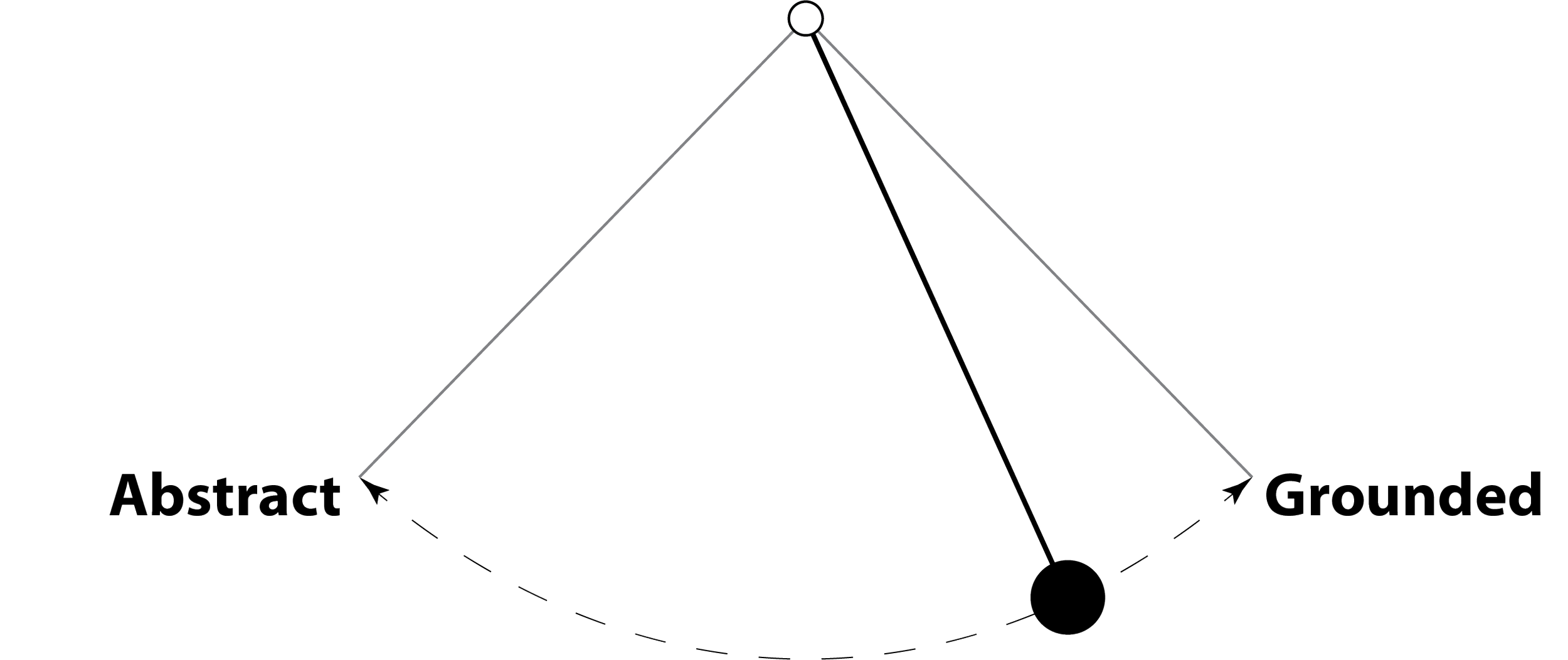
It is the ability to move, individually and collectively, between the abstract and the grounded:
The Abstract is about being able to step above the situation, to see patterns, spot connections, and synthesise a broad range of ideas into core themes. While often seen as the realm of strategy, it is actually required to deliver anything complex.
The Grounded is rooted in the practical and the experiential. It is understanding why the last major software change was so hard to implement, or why branch staff don’t like people from head office telling them what to do. It is embodied in the warning, "Unless you’ve been here 20 years, you don’t understand how this works."
The ability to swing between these two ends of the spectrum is at the heart of both creating a direction and successfully delivering it.
However, this is far more nuanced than simply labelling strategy as 'abstract' and execution as 'grounded'.
The 'Dog Food’ Test
Years ago, I learnt a simple test: if you can take your strategy, replace your company name with that of a dog food manufacturer, and the document still makes sense, you don’t have a strategy.
Dog food strategies lack relevance and often have filler words like ‘world class’, ‘technology enabled’ or ‘continuous improvement’. They come about because the strategy process is too abstract and not grounded in the practicalities of the current situation.
A strategy disconnected from reality will never be implemented because it stands on the false belief that concepts alone are good enough to hand over blindly to a delivery team. Without grounding, a beautifully formatted slide deck is just an expensive artefact. A real strategy tests what we hope to become against where we are right now. It recognises what is genuinely distinctive about the business. It also has a feedback loop from lessons that arise during delivery.
Drowning In Detail
Equally deadly to the delivery of a complex program is being flooded with details. When there are too many ideas without clear layering, teams simply don’t know where to start.
To avoid being lost in infinite options, the range of activities needs to be synthesised into clear themes so that everyone can see the whole territory and recognise what is important. This can be challenging in technical organisations, where every detail is critical, and technicians often struggle to prioritise tasks based on significance.
Delivery without the occasional abstraction can be brittle. Taking action throws up new data, and without the capacity to step back and incorporate these lessons, it just adds to the fog. Complexity can snowball as questions are raised, until the program collapses under the perplexity driven by emergent issues.
Balancing Hope and Reality
Effective delivery in complexity is never a linear process of design and build. It is an ongoing conversation between what we hope to achieve and the practical reality of what can actually be delivered. Too much ambition and nothing gets delivered. Too much practicality and nothing changes.
All the way through the program is a constant swing of the pendulum. Abstract to provide clarity. Ground to create progress.
This idea is similar to Rosabeth Moss Kanter’s concept of 'zoom in and zoom out' (Harvard Business Review, March 2011), which highlights the need to continually shift perspective for high performance.
Keep the Pendulum in Motion
Maintaining movement between the abstract and grounded means building the muscle to play at both ends of the spectrum:
Immerse your strategists: Get your conceptual thinkers out into the front-line operation so they can experience the reality of what it takes to both run and shift the organisation.
Lift the sights of the operators: Give your delivery teams the time, space and guidance to build a map of the terrain so they can see how all the pieces fit together.
Maintain the momentum: Keep the pendulum swinging all the way through implementation. Deliberately shift between the big picture and the front line views. Bring in different perspectives and framing, particularly when you have to navigate surprises.
Is your direction too theoretical? Does your implementation get bogged down in details? Or do you make time and space for the movement between the abstract and the grounded?
